Music Evolution
Complex Systems and Computational Methods in Interdisciplinary Research
During my PhD and postdoctoral years I worked doing research related to music from a Statistical Physics and Complex Systems perspective.
Music is a cultural phenomena that emerges from social and cultural interactions with individual and collective implications. It’s multi-scale and multi-factorial characteristics makes music a very appealing subject of study to understand problems related not only to socio-cultural behavior and evolution but also to cognitive processes such as creativity or innovation.
For this reason, identifying, quantifying and characterizing musical features is essential to explore more complicated aspects like cultural evolution or innovation.
Latest: the evolution of harmony paper is now published in PLOS One, and a new preprint on symmetry and motivic transformation in melodies is out.
Scaling and Nonlinearity in music scores
The auto-correlation function of a signal contains information about its structural properties. The scaling behavior of the auto-correlation function has been related to pleasantness in music ( noise) in previous studies. Here we show that there are different types of scaling behavior in music that were not documented before: two scaling regions and no clear scaling, we also show that having scale invariance ( noise) is not enough for music to be considered pleasant, finding that nonlinear features could play an important role in music enjoyment.

Read the paper here.
Musical narrative and the arrow of time in western classical music
Musical narrative -the sensation that music has a direction to go- generates expectation, however musicologists argue that for music to be pleasant it should have a balance between expectation and surprise. In this work we quantify irreversibility -the directionality- in melodies and relate it with interval asymmetry, finding a clear correlation between both quantities. We found that irreversibility is a universal property in music and is also related to nonlinear features that could be relevant to music enjoyment.

Read a Scientific American article about this work here or read the original paper if you prefer.
Quantifying the evolution of harmony and novelty in western classical music
Creativity and innovation are concepts difficult to define and quantify. Music offers a way to indirectly measure features related to innovation. We represent each piece as a sequence of local keys, computed bar by bar with a variant of the center of effect algorithm in Chew's spiral array, and define information-theoretic measures of key uncertainty (closely related to tonal tension), key diversity, and novelty in key transitions. Across 4,638 scores spanning 400 years, we confirm several trends reported by musicologists, with one discrepancy: harmonic innovation declines in the Early Classical period and then rises steeply in the Late Classical, consistent with accounts by music theorists. Comparing composers by their key-transition vocabularies, we find that they group by historical period, and their nearest neighbors recover connections documented in the historical record.
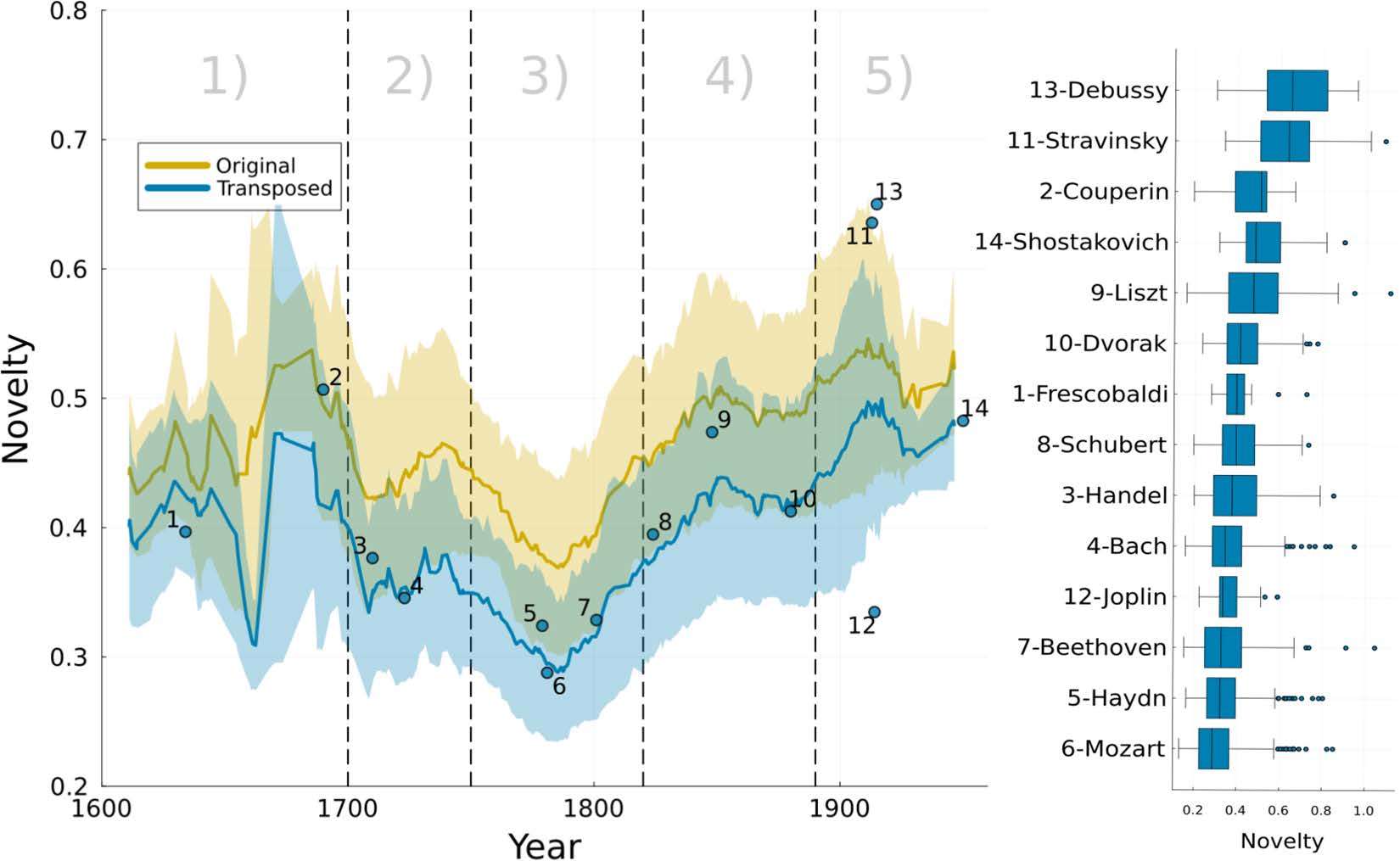
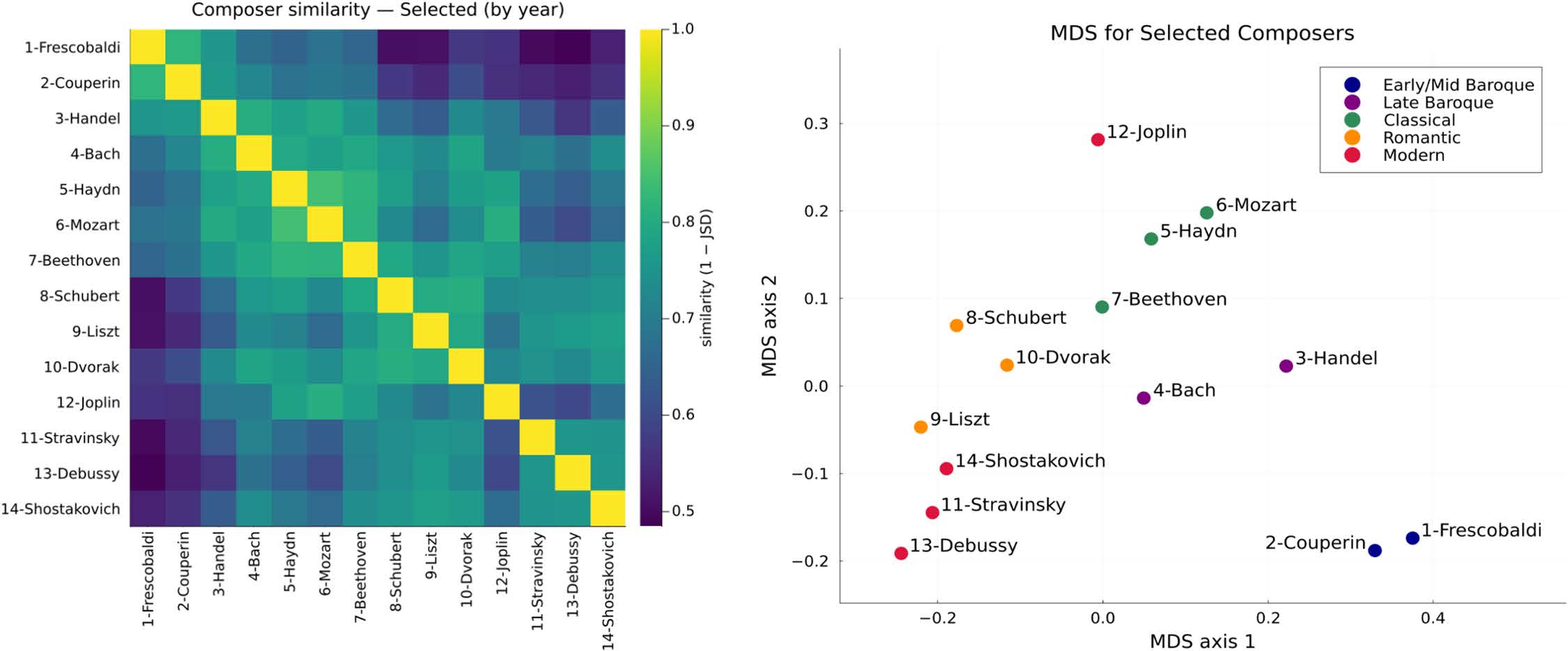
Top: novelty in key transitions over time. Bottom: composers compared by their key-transition vocabularies. Figures 5 and 6 from González-Espinoza & Plotkin (2026), CC BY 4.0.
Paper: PLOS One 21(8): e0356548 (2026) · Preprint · Data · Code
Read the CMU Libraries story about this work here.
Symmetric structure and motivic transformation in melodies
Transposition, inversion and retrograde are fundamental operations in music theory, from Schoenberg's twelve-tone technique to Lewin's transformational theory, yet their use in melodies has rarely been quantified. Borrowing the logic chemists use to classify molecules by their point group, we read a melody through the orbits and stabilizers of its short windows (3–6 notes) under the group generated by these operations. This splits the melodic entropy into a motivic vocabulary (orbit entropy) and how that vocabulary is deployed. In 852 keyboard pieces spanning four centuries, at least 97% of melodies use a smaller motivic vocabulary than surrogates that keep their pitch content, spectrum or note-to-note transitions. Recurring motifs are transposed by a fifth or fourth 2.8 times more often than chance, a preference that weakens from the Baroque to the 20th century, and from Bach's fugues to Shostakovich's. Retrograde is the musical counterpart of time reversal, which links this work to the arrow of time above.
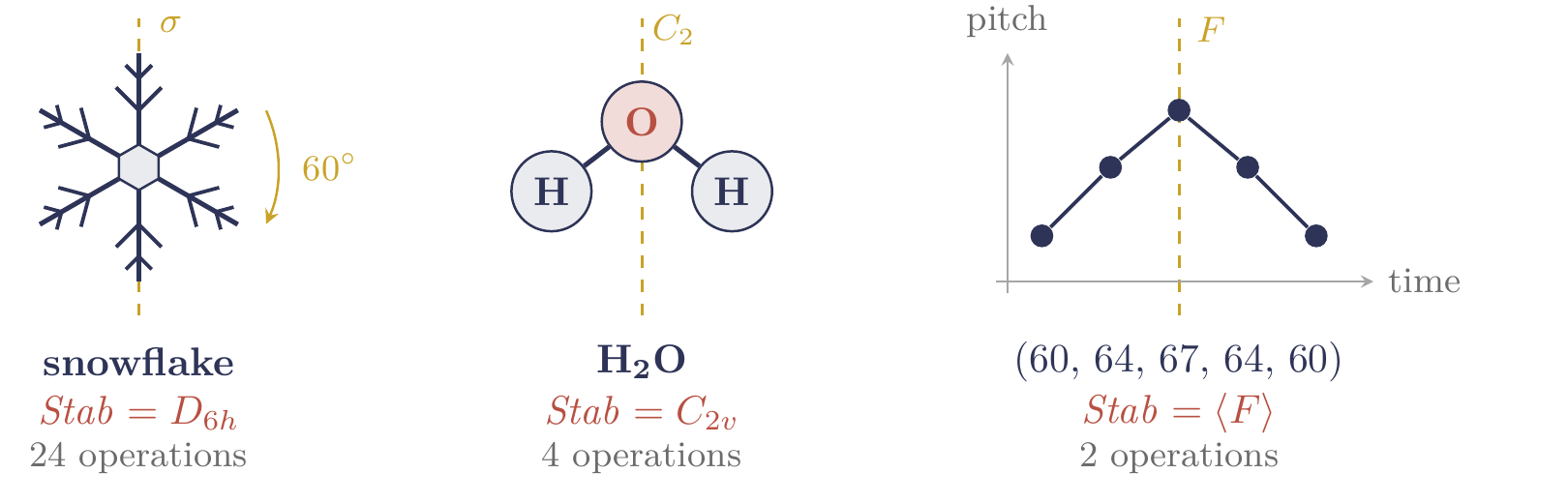
A snowflake, a water molecule and a palindromic motif, each classified by the operations that leave it unchanged.
Paper: Preprint
Frequency-dependent selection in music listenings
Work in progress.
Can we identify evolutionary signatures in social and cultural behavior? Can we understand underlying mechanisms when choosing what music to listen to, within the framework of evolutionary theory? – here we use evolutionary theory concepts to identify and measure frequency-dependent selection in listening histories.
